Showing posts with label politics. Show all posts

Tuesday, August 02, 2022

Sheer Pragmatism: J. Sakai, "Beginner’s Kata: Uncensored Stray Thoughts on Revolutionary Organization"


This 32-page digest-sized pamphlet published by Quebecois imprint Kersplebedeb was an excellent read to follow Maxim Raevsky’s Anarcho-Syndicalism and the IWW. I love reading materials from various times in radical history, and I ascribe them sizable inspirational, practical, and romantic value. I view such writers and subjects as heroes of history. 

Sakai’s slim volume, which is also available in full text—for free—on Kersplebedeb’s Web site, called me on the carpet and took me to task for doing so, encouraging me to apply the Zen concept of beginner’s mind to my political activism and labor organizing. Instead of relying on potentially outmoded and perhaps unsuccessful forms of organizing, we should focus on the modern day and sheer pragmatism: What tactics and techniques, what strategies, will help us accomplish our goals with the people, organizations, and structures we’re working with today?


In fact, Sakai cautions against defaulting to heroic moments such as the Russian Revolution of 1917 and the Spanish Civil War of 1937 as our frameworks and models for success. They might have succeeded, but not in a sustainable way. “[T]here are numbers of radical people as well as different groups with revolutionary ideas,” Sakai writes. “But if only temporarily, there is no revolutionary organization yet which is strong enough to impress its ideas against mainstream politics.”


If we presume that we don’t know anything about successful revolutionary organizing, what can we do? Sakai offers several ideas:


  • Learn to stop covering up your ignorance—readily admit when you don’t know something

  • Apply democracy selectively in organizations—Sakai suggests that the most effective work is often done in purely personal projects such as Jim Campbell’s Prison News Service and the National Committee to Defend Black Political Prisoners, which was largely run by one woman. Small group projects also show promise along these lines: “[Strip] away unnecessary people and organization… .”

  • Minimize emotional response and value judgments related to your work—instead of being thrown by events or feedback, just consider it as information: “Don’t think of what you’re being told as positive or negative. It’s just information.”

  • Avoid focusing on examples from the past that confirm or verify your existing beliefs or biases

  • Concentrate on building alternative structures


Sakai spends the rest of the pamphlet exploring that idea. They caution against merely criticizing or critiquing opponents, as well as falling prey to hopelessness. “We revs are always way outgunned and outnumbered by the mercenary forces of the capitalist state, until the final stages of the struggle,” Sakai writes. “Everything we do, our tactics and strategies, our organizations and subcultures, all assume great imbalances in strength between us and the capitalist ruling class.”


Small collectives, intellectual journals, and zines—even blogs—might not be enough. We need to reframe our thinking about revolutionary organization in terms of building revolutionary organizations. Easier said than done, but thought-provoking and inspiring all the same. What would that look like? How would it work? Who would you involve? What would you do?


“[Y]ou cannot be an individual revolutionary in any meaningful sense,” Sakai challenges. “[I]t is only complex revolutionary organization that lets our full political thoughts and intentions become full sails of reality.”

Saturday, July 16, 2022

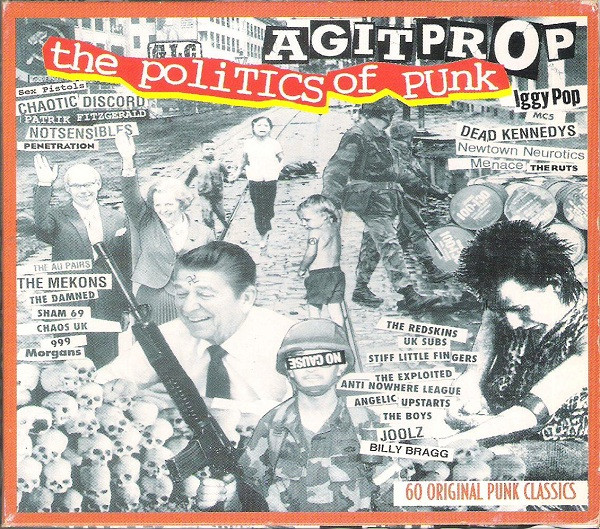
Raise Some Eyebrows: Various Artists, "Agitprop: The Politics of Punk"


I absolutely adore compilations like this. Before the advent of streaming music services, compilations ranked as one of the easiest ways to discover new music. In no particular order, the primary discovery methods included record reviews in magazines and zines; thumbing through the bins at record stores (even Music World); browsing the mail-order listings from Blacklist Mailorder and catalogs from J&R Music World (and to a lesser extent, the Columbia Record Club); music video programs on television such as 120 Minutes, Headbangers Ball, and Night Flight; mix tapes made by friends; trading tapes through the mail; select radio shows and stations; and—clearly—compilation records and tapes. 


All required you to do something other than just keep listening. Outside of those approaches, there were very few ways to determine whether you’d like a given band based on your affinity for other bands. In some record stores, the staff could be quite helpful, even disambiguating between Butthole Surfers and Couch Flambeau, believe it or not. I bought many a record because a reviewer compared a band to Bad Religion, Crimpshrine, or Descendents in the pages of Maximum Rocknroll.


Even today, you’d be hard pressed to have an algorithm or recommended mix offer such a tightly aligned selection of songs as that offered on this comp. This three-CD collection—I’m reviewing only the first compact disc—focuses on political punk music, either bands that were overtly political or songs that are explicitly political. The comp offers the benefits of the best comps—and runs the risks that all such compilation projects pose.


Here’s the track list, including an unlisted 20th song, along with cursory release info:


  1. The Ex Pistols, “Land of Hope and Glory” (Virgina [not a typo], 1984)

  2. The Mekons, “Fight the Cuts” (CNT, 1982)

  3. Redskins, “Unionize” (1987)

  4. Billy Bragg, “It Says Here” (Go!, 1984)

  5. Penetration, “Don’t Dictate” (Virgin, 1977)

  6. Poison Girls, “Old Tart” (Small Wonder, 1979)

  7. The Three Johns, “Death of the European” (Abstract, 1985)

  8. New Model Army, “Spirit of the Falklands” (Abstract, 1984)

  9. Joolz, “Paved with Gold” (Abstract, 1984)

  10. Morgans, “Atishoo” (only released on comps, active in the mid-1990s!)

  11. Dead Kennedys, “Chemical Warfare” (Cherry Red, 1980)

  12. Angelic Upstarts, “The Murder of Liddle Towers” (self-released, 1978)

  13. Patrik Fitzgerald, “Irrelevant Battles (Small Wonder, 1978)

  14. Newtown Neurotics, “No Respect” (Razor, 1983)

  15. Stiff Little Fingers, “Suspect Device (Live)” (Rigid Digits, 1978; live on Link, 1988)

  16. Chelsea, “Right to Work” (Step-Forward, 1977)

  17. Chaos UK, “Selfish Few” (active in early 1980s, released on single comps in early 1990s)

  18. Chaotic Dischord, “Fuck Religion, Fuck Politics, Fuck the Lot of You” (Riot City, 1983)

  19. The Exploited, “Hitler’s in the Charts Again” (Secret, 1981)

  20. 999, “Bye Bye England” (active on major labels in late 1970s, collected in early 1990s)


On the upside, Agitprop is an excellent collection of adjacent and similar music. Mostly released on independent labels in the late 1970s to mid-1980s, the bands and songs represented are predominantly British. The Dead Kennedys are the one exception, even though Fresh Fruit for Rotting Vegetables was released in the United Kingdom before Alternative Tentacles released it domestically.


The comp is also a wonderful mix of better-known (ahem, Billy Bragg) and lesser-known acts. For those listeners not already steeped in this kind of music, it’s sure to raise some eyebrows and tickle one’s fancy. For me, the surprises were the funky Redskins number reminiscent of the Clash, Penetration’s clarion call for freedom (among the oldest songs on the collection), the Three Johns (whoah; who are they?), and Patrik Fitzgerald’s brief barnstormer about distraction. I was also reminded how awesome the Mekons’ early recordings are—and how much the band has evolved; so glad they’re still recording—how one can always listen to more New Model Army, Angelic Upstarts, and Newtown Neurotics; and to spend more time with Poison Girls, an anarcho-punk band that was fronted by a middle-aged woman and worked closely with Crass.


If a listener digs a little deeper to learn more about where the songs come from—this collection didn’t come with much in the way of liner notes—one can even identify labels that might be worth more attention. In the case of this comp, Abstract Records and Small Wonder Records are the standouts. In addition to Joolz, New Model Army, and the Three Johns, Abstract also released records by Exposure, the Gymslips, Plain Characters, and Nikki Sudden—all of which I plan to check out. Similarly, Small Wonder—home of Patrik Fitzgerald and Poison Girls—also put out work by the Carpettes, the Cravats, and the Molesters, none of which I’ve previously been aware. (I would not have been able to so easily and quickly make those connections before the Web. Thank you, Discogs!)


On the downside, given the vagaries of clearing music rights, the collection occasionally offers odd versions of a song—because it’s the one they could secure rights for. So, instead of the Sex Pistols (newly relevant given the Disney+ TV show; see the Paul Cook interview in the current issue of Vive Le Rock), Agitprop includes a song by the Ex Pistols, Dave Goodman’s somewhat controversial sound-alike band (though the vocalist, credited as Rotten Johnny, could easily be mistaken for Johnny Rotten). We also get a live version—credited as such—of Stiff Little Fingers’ “Suspect Device,” though still wonderful, perhaps culled from a later performance. Redskins’ and Angelic Upstarts tracks are also live recordings. While the comp might feature original performers, these aren’t all necessarily initial recordings.


But the primary outlier on the disc is the Morgans song. The band, while British, was active well outside the era represented by the other tracks—a full decade later! Even though the song, “Atishoo,” is still relevant given COVID-19, it’s a bit of an odd duck on the collection. The band released several singles on Diversity and Rented Life in the mid-’90s and recorded an album. Gang of Four’s Andy Gill even produced some Morgans songs. But the band’s legacy is mostly left to strange occasional appearances on compilations, which vocalist Chloe LeFay credits to their former manager’s absconding with the rights. Ransom offers a wonderful examination of the history of the band in his blog Chronological Snobbery. The song was also included in Dressed to Kill’s six-CD 1999 compilation, The Shit Factory, which basically includes this CD—the first of Agitprop—as its fourth disc, quite the example of creative reuse.


In terms of the compilation’s theme, most of the songs are explicitly political—through the lens of the late 1970s and early 1980s—and address topics such as patriotism, labor organizing, truth in journalism, freedom, gender relations and rights, aging, homelessness, war, police brutality, double standards, and more. It strikes me that it’s odd to be so enthusiastic about a set of songs focusing on such dire subjects, but we need more music like this, not less.


As the CD’s back cover says, “Whoever you vote for, the government gets in.”


The songs are available as a playlist so you can start poking around yourself, too. The songs Spotify recommends at the end of the 20 tracks might not be as political, but the bands are definitely promising.


Tuesday, May 31, 2022

Book Review: "The Politics of Fandom" by Hannah Mueller

The Politics of Fandom by Hannah Mueller (McFarland, 2022)

If you recently read Jeffrey Redmond’s article “Politics in Science Fiction” in Ionisphere #34 or my piece “Fanatiquette: The ‘New’ Fan Etiquette,” you might also be intrigued by this book, published just this year. Originally offered as a dissertation at Cornell University, the book explores in depth the kinds of conflicts that can threaten and sometimes unify the various people and communities involved in fandom.

Similar to most recent fandom studies texts, the book distinguishes between literary or affirmational fandom (those who like to read and publish fanzines) and media or transformative fandom (those who like to watch and create). (I know that’s an oversimplification, but I’m suspicious that transformative fan terms are mostly used by transformative fen and academics. Affirmational fen have an opportunity to discover new forms of fan activity and new ways to communicate.) The book, written by the managing editor of Diacritics, considers both types of fandom through a transformative lens and offers several ideas for those interested in bridging the older generations of fen and newer, younger fen. Those opportunities for bridge building are welcome and inspiring to at least this fan, who increasingly feels at home in both camps.

Over the course of the book, Mueller considers a handful of case studies offered as instructive examples of political conflicts dating back to the earliest days of fandom. In fact, there are at least two issues of Tightbeam included among the citations, as well as Donald Franson’s 1962 N3F Fandbook Some Historical Facts About Science Fiction Fandom. The N3F also shows up in the index.

The conflicts considered by Mueller include the Great Exclusion of 1939, in which the Worldcon organizing committee ostracized politically outspoken participants. That con lobby skirmish led to the formation of New Fandom and eventually the National Fantasy Fan Federation. Mueller does well to compare the two groups’ approaches to considering the role of politics in sf, fantasy, and horror. She also considers the Breen Boondoggle in 1964, in which fen decided to exclude Marion Zimmer Bradley’s husband Walter Breen from Pacificon II and the Fantasy Amateur Press Association (or its wait list, at least). While less explicitly political in nature, that controversy again highlighted aspects of inclusivity and exclusivity in fandom, focusing on how adults interact with children in fannish and other settings.

The book then fast forwards to several more recent political movements within fandom, including RaceFail ‘09, which took place primarily on LiveJournal rather than in fanzines—highlighting transformative fandom’s move online to platforms such as fan fiction repository Archive of Our Own—in which fen and professionals alike considered the role of race (and by extension, the working class, the poor, and women) in literature and media, as well as within fandom itself. Of special note in this chapter is Mueller’s consideration of fan-pro relationships and the role of authority, hierarchy, and power in political conflict within fandom. While several newly popular authors have emerged from RaceFail, the pros challenged at the time didn’t necessarily hold their own with grace and charm.

Also considered in the text: Puppygate and its impact on Hugo voting; how an influx of Twilight fen affected cons and fandom; the role of cosplay and other transformative fan activities; Glee fen and their criticism of the television show when it started to stray from topics and themes that initially attracted fen; and the transmedia marketing of The Hunger Games, which enabled fen to participate on both sides of the novels’—and movies’—narrative politics, introducing questions about and concerns with the commercial aspects of fan activity.

All in all, Mueller does well to examine the cohesion of community and ideals of tolerance within fandom, the tensions between hierarchical organization models and looser online networks of fen, and the desire for entertainment as well as social change. “[T]ransformative fans are starting to appear as equal to, and in some ways even more influential than the affirmational fans of literary science fiction and fantasy,” Mueller wrote. “[T]he divide between politically progressive and politically conservative fractions of fandom has in fact deepened once more, and the feuds that are carried out between different camps in the fannish sphere are more directly and openly connected to national and global political developments than perhaps ever before in fandom history.”

What’s missing in the book, through no fault of the text itself, is a solution—or solutions. One of the things that struck me is that requests to not discuss politics in fannish spaces are often arguments for the continuation of traditional politics, even if not positioned explicitly as such. Perhaps it’s not whether we talk about politics in fandom but how we do so. This book is a lively, wide-ranging first step toward finding such solutions.

Tuesday, June 10, 2008

Grassroots Use of Technology

This looks like an interesting conference:

When: Saturday, June 28th - All Day (8:30am to 6pm)
Where: University of Massachusetts Lowell - Wannalancit Building, 600 Suffolk Street, Lowell, MA

Highlights of the day:

* Keynote Speaker, Nick Jehlen of Action Mil draw lessons from his recent work on the Winter Soldier campaign organized by Iraq Veterans Against the War.
* Non-profit Internet Starter Kit: Take Your Website to the Next Level with These Free Online Tools
* Online Mentoring: Innovative Uses of Technology in Creating and Managing Mentor-Mentee Relationships
* You Can't Get What You Want Until You Know What You Need: Choosing the Right Software
* Making the Most Out of the Organizers' Database
* The Untapped Power of Social Networks for Grassroots Action
* Getting the Clicks: e-Campaigning in Communities with Few Computers
* Managing Your Website with Today's Tools
* Search Engine Optimization (SEO) Roadmap
* HAVA Great Idea? (HAVA stands for Help America Vote Act)
* Facebook to Phone Trees: Multi-Generational Outreach Strategies
* Organizing the Organic Internet
* Helping Your Computer System Grow Up
* Keeping it Simple: technology tools that won't make you want to rip your hair out.
* Collaborative eLearning
* The Point: A Web-Tool for Collective Action
* Managing & Recruiting Tech volunteers
* Strategies for shaping the media/tech future: Policy, funding & organizing
* Open Media Boston: Building a News Portal with Drupal

Lowell is a beautiful, historic city that still remembers its working-class roots The intersection of rivers and canals make it a wonderful place to be on an early summer day. So join us for some engaging connections and some rock-solid knowledge sharing.


If any Media Dieticians go, consider submitting a report! (Or blogging it yourself.)

Tuesday, April 22, 2008

Post-Huffington


Multimedia message
Originally uploaded by h3athrow
This evening -- early, at 5:30 -- I went to my first 212 event, a free talk by Arianna Huffington moderated by Kate Kaye, senior editor of ClickZ.

Because I went more for the content than the community, I didn't network much at all, pretty much making a bee line for a good seat in order to hear what Huffington had to say. In many ways, the talk was one of a single tension -- Kaye wanted (and the audience wanted) Huffington to talk about the impact of online marketing and advertising on the political campaign process, while Huffington seemed to want to stick to politics and campaigning in general. That might be appropriate on the eve of the Pennsylvania primary, but exit polls (read: the conversation during the elevator ride down afterward) indicate that people wanted more on-topic discussion.

Regardless, Huffington had some interesting stuff to say. She criticized Clinton's use of terrorism and fear as a campaign tool, questioned the practice of hiring campaign managers who've lost previous campaigns, claimed that this year's election cycle marks the "first real Internet campaign," suggested that primary campaigns should be run more mindfully that someone from the party will be running -- indicating that primary campaigns shouldn't give the main election's opposition party tools to use against the party's representative -- and proposed that the print vs. Web debate is yesterday's news.

That led to what might be the soundbite of the evening: "The question of print vs. online seems to me to be an obsolete debate. It's like the old barroom argument: Ginger or Mary Ann? It's 2008; let's have a three way."

In fact, that's my primary criticism of the evening's gambit. Online campaigning -- online marketing -- isn't that interesting when considered outside the context of the overall campaign or marketing strategy. This campaign isn't about online advertising. It's about reaching voters in the right way at the right time in the right place. Multiple media can accomplish that goal.

The Democratic candidates seem to understand that, with Obama focusing on the youth vote and using inclusive language online -- just as the Republicans and far right have taken to the air waves with talk radio. Maybe the next election cycle will be the first integrated campaign.

I've not read a lot of Huffington's writing, but on the basis of tonight, I might have to check out her forthcoming book, Right Is Wrong. Like she said, society (and culture and media) doesn't have to accept the framework of the right.

Just like we don't have to look at things in terms of online vs. offline.

Saturday, December 22, 2007

An Open Letter to Vladimir Putin

Inspired by a recent screening of Sicko, an Amnesty International campaign, and today's Garry Kasparov op-ed in the Wall Street Journal, I wrote the president of Russia a letter.

President of the Russian Federation
Vladimir Vladimirovich Putin
Rossiiskaia Federatsia
103132 g. Moskva
4 Staraya Ploshchad
Prezidentu Rossiiskoi Federatsii
PUTINU V. V.

RE: Reopen the investigation into student Artur Akhmatkhanov's disappearance

Dear President Putin,

While I've yet to pick up the current issue of Time magazine, which lauds you as the 2007 Person of the Year for helping create a new Russia, I can't help but think about the ironies involved in this announcement. If you are one of the more progressive and successful world leaders, how can instances like Artur Akhmatkhanov's disappearance -- and Yury Chervochkin's death -- continue to happen under your authority?

I call on you to explain why the investigation into the enforced disappearance of Akhmatkhanov was suspended in mid-2007. This is especially concerning given that the Chair of the Chechen Parliament’s commission for the search for abducted and missing persons pledged that they would try to discover the fate of all missing persons by the end of this year.

Please reopen the investigation immediately and ensure it is conducted in a thorough, independent, and effective manner. The findings should be made public, and the perpetrators must be brought to justice. Additionally, Akhmatkhanov’s family should be kept fully informed of all developments in the investigation.

I further call on you to conduct an official inquiry into the effectiveness of the investigations into enforced disappearances. Numerous judgements of the European Court of Human Rights have found the Russian authorities guilty of violations of the European Convention on Human Rights and of failing to investigate them effectively and to take steps to end violations committed by Russian security forces and to ensure that law enforcement agencies operate in full accordance with Russian and international law.

Garry Kasparov's recent piece in the Wall Street Journal (Dec. 22, 2007) also concerns me. If you are indeed worthy of Time magazine's mantle, if you are indeed dedicated to being a respectable and progressive leader for Russia, if you are an ethical and moral human being, please end the attacks on those trying to bring a true democracy to your country. Don't fall prey to the allure of being a bully and a dictator. Because if you do, the new Russia won't be much different than the old Russia, and the country's newfound political strength will be a sign of your moral weakness.

Sincerely,
Heath Row

Cc: U.S. Senator Hillary Clinton and U.S. Senator Charles Schumer


If you ever get the urge to write or otherwise contact a political leader, I encourage you to do so. The best way to celebrate the rights you have is to use them.

Thursday, July 05, 2007

Event-O-Dex XXXIII

Wednesday, July 11: Bernardine Dohrn, "Sing a Battle Song: The Revolutionary Poetry, Statements, and Communiques of the Weather Underground" reading, 7 p.m., Bluestockings, 172 Allen St., New York. This book collects the three complete and unedited publications produced by the Weather Underground during their most active period.

Thursday, July 12: Patton Oswalt, 8 p.m., Sound Fix, Brooklyn. From the invite: "The famed funnyman ... makes his ONLY New York appearance of this tour, for his official album release show."

Friday, July 13: "Lenin For Your Library?" book launch and discussion, 7 p.m., Orchard, 47 Orchard St., New York. From the invite: "The project Lenin For Your Library? began in Spring 2005 when Yevgeniy Fiks sent one hundred copies of Imperialism the Highest Stage of Capitalism by V.I. Lenin to the addresses of major global corporations (Gap, Coca-Cola, General Electric, and IBM among many others) with an enclosed letter, offering the book as a donation to the corporate library. Out of one hundred copies sent, fourteen were acknowledged with "thank you" letters. Seventeen were returned with letters stating various reasons for rejection (focus of library collection, policy of not accepting gifts or donations from private individuals, est.). The fate of the remaining sixty-nine copies remains unknown. ... The original 31 letters received from the corporations will be on display at Orchard during the event."

Sunday, July 22: Peter Kuper and Kevin Pyle reading, 7 p.m., Bluestockings, 172 Allen St., New York. World War 3 Illustrated co-editors unveil their latest graphic novels, "Stop Forgetting to Remember" and "Blindspot."

Wednesday, June 27, 2001

From Pylon to the Prospect

Ate lunch at Artu today with Robin Hutson, the new publisher of the American Prospect. She moved to Boston from New York City after working at Lingua Franca, and even though she's only been here three months, she already has a lot of ideas on how to refresh the Prospect's look and feel, how to better engage new readers, and how the Prospect might be able to connect a community of like-minded political thinkers and activists around the country. Better yet, Robin's got a zine background. Growing up in Tennessee, she edited a straight-edge punk and hardcore fanzine called Pylon. Unfortunately, even Robin has no back issues available. For shame!