Showing posts with label media. Show all posts

Monday, April 28, 2008

What If Ads Were Content? Redux

This past weekend, I participated in the second Podcamp NYC, a lively unconference focusing on podcasts and other new, social media. As a followup to last year, I gave a talk reconsidering the idea of social advertising and content-driven advertising -- what Rick Bruner calls Advertising 2.0.

Saturday was exactly 377 days after my last talk on that topic, and a lot has happened in terms of widget advertising, social media, and other experiments involving social ads. Here's the presentation:


Let me know what you think!

Tuesday, April 22, 2008

Post-Huffington


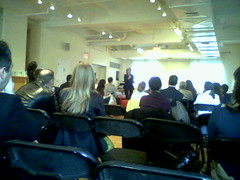
Multimedia message
Originally uploaded by h3athrow
This evening -- early, at 5:30 -- I went to my first 212 event, a free talk by Arianna Huffington moderated by Kate Kaye, senior editor of ClickZ.

Because I went more for the content than the community, I didn't network much at all, pretty much making a bee line for a good seat in order to hear what Huffington had to say. In many ways, the talk was one of a single tension -- Kaye wanted (and the audience wanted) Huffington to talk about the impact of online marketing and advertising on the political campaign process, while Huffington seemed to want to stick to politics and campaigning in general. That might be appropriate on the eve of the Pennsylvania primary, but exit polls (read: the conversation during the elevator ride down afterward) indicate that people wanted more on-topic discussion.

Regardless, Huffington had some interesting stuff to say. She criticized Clinton's use of terrorism and fear as a campaign tool, questioned the practice of hiring campaign managers who've lost previous campaigns, claimed that this year's election cycle marks the "first real Internet campaign," suggested that primary campaigns should be run more mindfully that someone from the party will be running -- indicating that primary campaigns shouldn't give the main election's opposition party tools to use against the party's representative -- and proposed that the print vs. Web debate is yesterday's news.

That led to what might be the soundbite of the evening: "The question of print vs. online seems to me to be an obsolete debate. It's like the old barroom argument: Ginger or Mary Ann? It's 2008; let's have a three way."

In fact, that's my primary criticism of the evening's gambit. Online campaigning -- online marketing -- isn't that interesting when considered outside the context of the overall campaign or marketing strategy. This campaign isn't about online advertising. It's about reaching voters in the right way at the right time in the right place. Multiple media can accomplish that goal.

The Democratic candidates seem to understand that, with Obama focusing on the youth vote and using inclusive language online -- just as the Republicans and far right have taken to the air waves with talk radio. Maybe the next election cycle will be the first integrated campaign.

I've not read a lot of Huffington's writing, but on the basis of tonight, I might have to check out her forthcoming book, Right Is Wrong. Like she said, society (and culture and media) doesn't have to accept the framework of the right.

Just like we don't have to look at things in terms of online vs. offline.

Saturday, February 16, 2008

Media Diet Book Club: Forthcoming Books 2008

This is an incomplete list of media- and journalism-related books scheduled to be published this year. If you're aware of others that you think are worth mentioning in Media Diet, let me know!

  • Ultimate Blogs: Masterworks from the Wild Web
  • A Journalism of Humanity: A Candid History of the World's First Journalism School
  • Can We Trust the BBC?
  • Principles of Convergent Journalism
  • Media in the Digital Age
  • The Place to Be: Washington, CBS, and the Glory Days of Television News
  • The Flash Press: Sporting Male Weeklies in 1840s New York
  • Center Field Shot: A Hitory of Baseball on Television
  • Scandal and Civility: Journalism and the Origins of American Politics
  • Understanding Media Economics
  • From Betamax to Blockbuster: Video Stores and the Invention of Movies on Video
  • Deep Time of the Media: Toward an Archaeology of Hearing and Seeing by Technical Means
  • Stealing Empire: P2P, Intellectual Property and Hip-Hop Subversion
  • Shock Jocks: America's Talk Radio Problem
  • Power, Politics and Identity in South African Media
  • Coming of Age in Second Life: An Anthropologist Explores the Virtually Human
  • Virtual Identities: The Construction of Selves in Cyberspace
  • The Dumbest Generation: How the Digital Age Stupefies Young Americans and Jeopardizes Our Future (Or, Don't Trust Anyone Under 30)
  • It's Not News, It's Fark: How Mass Media Tries to Pass Off Crap As News
  • Playing the Past: History and Nostalgia in Video Games
  • The Environment and the Press: From Adventure Writing to Advocacy
  • We're All Journalists Now: The Transformation of the Press and Reshaping of the Law in the Internet Age
  • Off the Record: The Press, the Government, and the War over Anonymous Sources
  • The Media and Peace
  • The Mechanical Bride (Facsimile)
  • Infotopia: How Many Minds Produce Knowledge
  • Two Bits: The Cultural Significance of Free Software
  • White News: The Untold Story of Racism in American Media and the Journalists Who Fought It
  • A TV Guide to Life: How I Learned Everything I Needed to Know From Watching Television
  • The Conservative Resurgence and the Press: The Media's Role in the Rise of the Right
  • Sounds of Change: A History of FM Broadcasting in America
  • Echo Chamber: Rush Limbaugh and the Conservative Media Establishment
  • The Social Media Playbook: Listen, Look, Join and Lead
  • Global Bollywood
  • Digital Destiny: New Media and the Future of Democracy
  • Global TV: Exporting Television and Culture in the World Market
  • The Encyclopedia of Reality Television: The Ultimate Guide to Over 20 Years of Reality TV from The Real World to Dancing with the Stars
  • The Al Jazeera Effect: How the New Global Media Are Reshaping World Politics
  • Losing the News: The Uncertain Future of the News That Feeds Democracy
  •